Brushless Motors 101: Efficiency, Control, and Applications
Brushless DC motors pair high efficiency with low maintenance, precise electronic control, and quiet power for drones, EVs, robots, and automation.
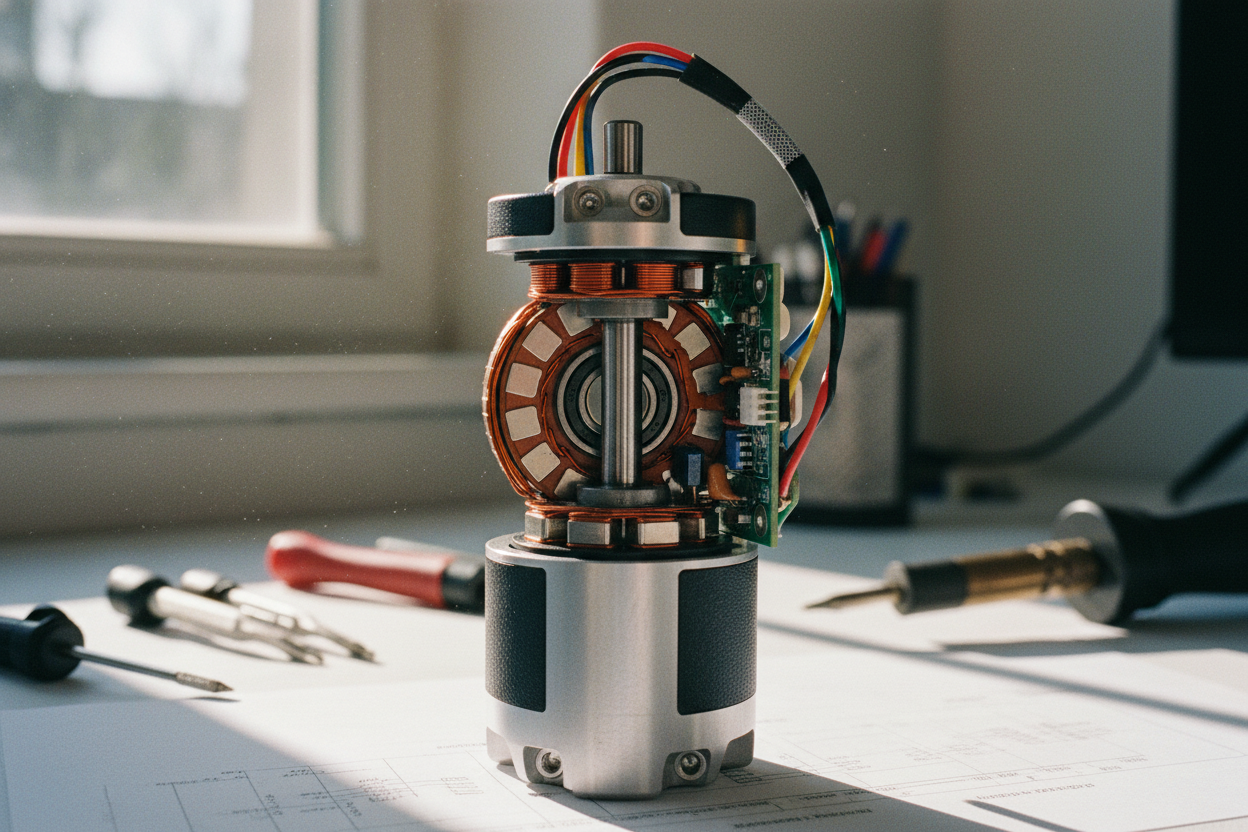
Fundamentals of Brushless Motors — A brushless DC motor (BLDC) combines a stationary stator with energized windings and a rotating rotor carrying permanent magnets, eliminating mechanical commutators and brushes. The absence of brushes reduces friction, arcing, and wear, enabling higher efficiency, better torque density, and quieter operation. BLDC motors rely on electronic commutation to sequence current through the stator phases, creating a rotating magnetic field that pulls the rotor along. Designers value the linear relationship between torque and current, as well as predictable speed–voltage behavior defined by the motor's kV and torque constant (kT). Compared with brushed motors, brushless machines maintain performance over long duty cycles with minimal maintenance, especially under variable loads. Their compact form factors, high power-to-weight ratio, and strong dynamic response make them ideal for precise actuation. Understanding terms like back-EMF, cogging, and slot fill helps decode datasheets and anticipate behavior under different loads, while appreciating the interplay between windings, magnets, and controller algorithms sets the foundation for effective application and integration.
How Electronic Commutation Works — In a BLDC system, an inverter (often called an ESC) switches DC into three-phase AC-like waveforms using PWM, driving the stator to produce a rotating field. Position feedback comes from Hall sensors, encoders, or sensorless estimation derived from back-EMF. Two common drive styles are trapezoidal commutation, which is simple and robust, and sinusoidal or FOC-based control, which reduces torque ripple and acoustic noise. The controller sequences phase currents so that rotor magnets continuously chase the moving stator field. At low speeds, sensorless methods can struggle due to weak back-EMF, so sensored startup or hybrid strategies are popular. At high speeds, switching frequency, dead-time, and timing advance influence efficiency and stability. Good commutation protects against shoot-through, manages current slew, and coordinates brake and regen events. Ultimately, precise commutation aligns the electromagnetic torque with rotor position, maximizing output while minimizing heat, vibration, and losses across a wide operating envelope.
Efficiency and Thermal Management — BLDC efficiency hinges on minimizing copper losses (I^2R), iron losses (hysteresis and eddy currents), and switching losses in the inverter, while keeping mechanical losses low through quality bearings and careful balancing. Higher slot fill, thicker copper, and optimized winding resistance reduce heating at continuous load. Laminated stators, tailored magnet grades, and intelligent PWM lower core losses. On the electronics side, appropriate switching frequency, gate drive, and dead-time tuning cut transition waste. Thermal performance benefits from effective heat paths: metallic housings, heat sinks, directed airflow, and thermal interface materials that pull heat from windings and FETs. Monitoring current, temperature, and voltage enables derating under heavy duty cycles to protect magnets from demagnetization. Matching the motor's kV to the supply and gearbox, and running within the sweet spot of the efficiency map, prevents overspeed or overcurrent conditions. Thoughtful gearing or prop sizing lets the motor operate near peak efficiency, yielding longer runtimes, higher reliability, and consistent performance in real-world environments.
Control Strategies for Precision — Advanced control elevates BLDC performance from merely fast to truly precise. Field-Oriented Control (FOC) transforms measured currents into dq-axes, regulating torque-producing and flux components independently for smooth output and low noise. A layered loop structure—current loop, velocity loop, and, when needed, position loop—enables tight regulation under disturbances. PID remains a staple, often augmented with feedforward, anti-windup, and notch filters to reject resonances. Sensorless control leverages back-EMF or observers for compact builds, while sensored control with Halls or encoders excels at low-speed positioning and dynamic reversals. Features like field weakening extend speed range, and torque linearization plus anti-cogging tables sharpen low-speed smoothness. Practical tuning demands safe current limits, slew-rate constraints, and comprehensive fault handling for overcurrent, overtemperature, and undervoltage events. With well-tuned loops, the motor tracks commands crisply, holds position against load variation, and delivers repeatable motion in robotics, machine tools, and precision pumps.
Design, Sizing, and Integration — Successful projects start with the torque–speed requirement: define continuous and peak torque, desired top speed, and allowable thermal rise. Choose a motor whose kV, kT, and voltage rating align with the power bus and duty cycle, then pair it with an ESC that exceeds expected phase current and supports the chosen control mode. Consider gearing to place operating points near efficiency peaks while meeting acceleration targets. Plan for EMI/EMC with twisted pairs, short return paths, proper grounding, and shielding around the inverter. Mechanical integration needs rigid mounting, correct axial and radial load handling, and careful coupling to minimize misalignment and vibration. Add thermal sensors, current sensing, and fusing for protection. Select connectors and cabling sized for surge currents and environmental conditions. Validate performance on a dynamometer or controlled test rig, map efficiency and temperature versus load, and update limits in firmware. This holistic approach yields a balanced, robust system with headroom for transients and aging.
Applications and Use Cases — BLDC motors power a wide range of systems where efficiency, controllability, and reliability are essential. Lightweight, high-power-density designs excel in aerial platforms and mobile robots, where precise throttle response and long runtimes matter. In e-mobility and light traction, their flat torque from low speeds and regenerative capability support smooth launches and efficient braking. HVAC fans and pumps benefit from quiet sinusoidal control, delivering variable flow with reduced energy use. In CNC spindles, gimbals, and actuators, low torque ripple and accurate speed or position loops translate to superior surface finish and stabilization. Appliances and medical devices value low maintenance, compact packaging, and clean operation without brush dust. Selection varies by need: high-pole outrunners for high torque at low rpm; inrunners for compact, high-speed drives; integrated servo packages for precise motion. With thoughtful pairing of motor, controller, mechanics, and thermal design, BLDC technology adapts seamlessly across industries and duty cycles.