Stepper vs Servo Motors: Precision, Speed, and Control
Compare stepper and servo motors across precision, speed, torque, and control. Learn selection tips, typical applications, and cost-performance tradeoffs.
Understanding the Fundamentals
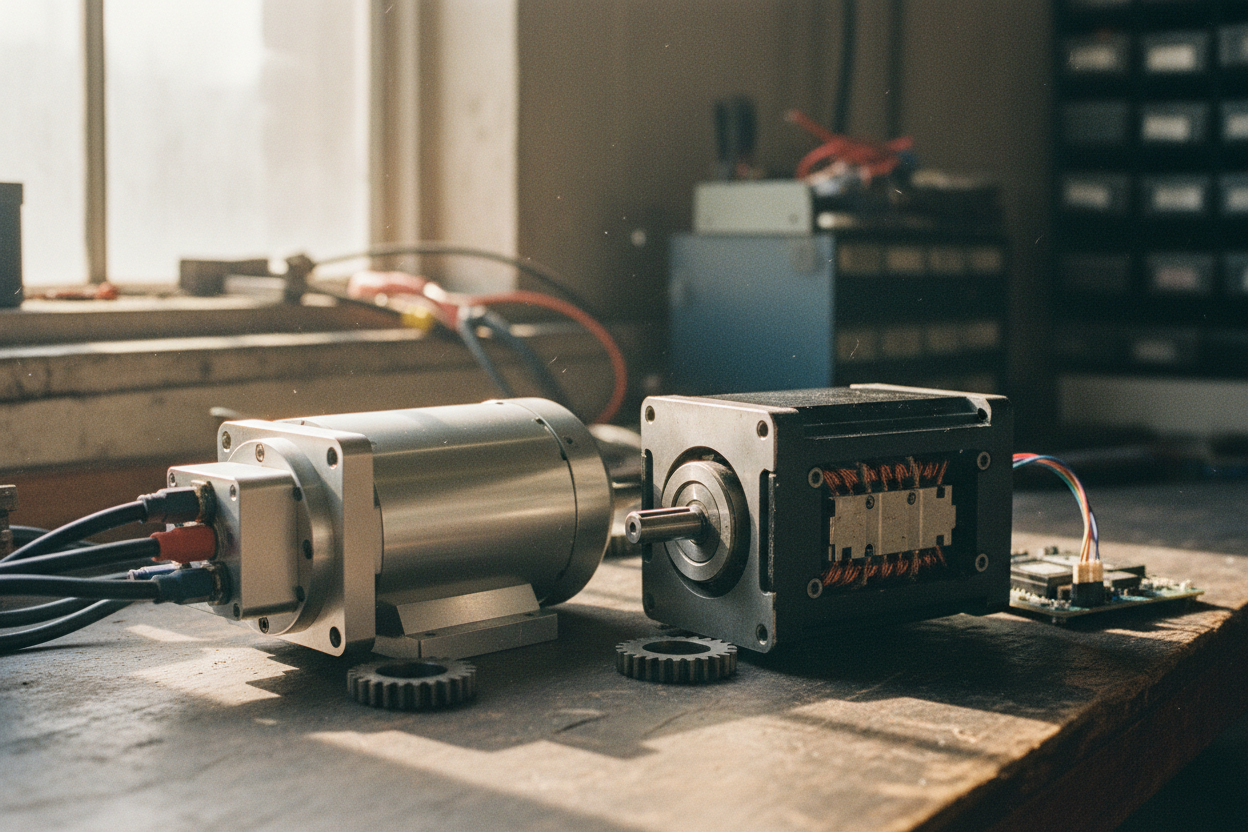
Stepper and servo motors are both essential actuators for motion control, but they approach movement in distinct ways. A stepper motor advances in discrete steps, driven open-loop by timed current pulses that energize stator phases to position the rotor incrementally. This makes position commands straightforward and predictable without mandatory feedback. A servo motor, by contrast, runs closed-loop using encoders or resolvers to measure shaft position and velocity continuously, adjusting drive output to follow a commanded trajectory. Steppers excel at low-speed positioning, holding torque, and simplicity of integration, often with lower overall system cost. Servos excel at high-speed motion, smoothness under varying loads, and precise following of complex motion profiles. Both technologies span a range of sizes and drivers, from compact modules to industrial packages. When comparing them, think in terms of control philosophy, expected loads, duty cycles, and the level of precision, speed, and control the task requires, rather than assuming one is universally better. Aligning technology to the motion profile is the most reliable path to success.
Precision and Resolution
Precision means more than tiny steps. A stepper motor offers inherent resolution defined by its step angle, which can be refined with microstepping to create smoother motion and reduce vibration. However, microstepping improves interpolation, not fundamental accuracy, so load changes, friction, and compliance can shift the final position. Typical repeatability is strong, especially under constant load, and holding torque resists back-driving when power is applied. A servo motor derives resolution from its encoder or feedback device, often reaching extremely fine increments that enable high absolute accuracy when the mechanism is well designed. Because a servo is always comparing command to measured state, it can correct for disturbances, backlash, or temperature effects. Still, poor tuning or mechanical looseness can cause overshoot or oscillation. Detent torque in steppers may help with static positioning but can induce ripple at low speeds; encoder quantization in servos can introduce noise if not filtered. Evaluate command resolution, true accuracy, and long-term repeatability, and consider the entire mechanical loop including couplings, gearboxes, bearings, and structural stiffness.
Speed, Torque, and Dynamic Behavior
Speed and torque performance differ markedly between the two. A stepper motor delivers strong low-speed torque and can hold position without a brake, but torque typically declines as speed increases, and the system may encounter resonance bands. At higher rates, missed steps can occur if commanded acceleration exceeds available torque. A servo motor generally maintains a flatter torque curve over a broader speed range and supports aggressive acceleration and deceleration with rapid settling time. With proper inertia matching, a servo achieves smooth motion across the entire envelope, even with varying loads. Steppers respond well to microstepping and anti-resonance techniques, which improve smoothness but cannot fully overcome torque roll-off at high speeds. Servos leverage feedback to adapt to disturbances and deliver consistent motion profiles, making them ideal for fast indexing, contouring, and synchronized axes. When cycle time, throughput, and responsiveness are critical, servos usually lead; when low-speed torque, simplicity, and stable positioning dominate, steppers remain compelling.
Control, Tuning, and Feedback Strategies
Control architecture shapes the user experience. Open-loop stepper systems use simple step-and-direction signals, with drivers providing current control, microstepping waveforms, and sometimes anti-resonance algorithms. They are quick to commission and predictable when loads are known. Advanced drivers add stall detection or hybrid closed-loop feedback for alarmed recovery, blending stepper torque with servo-like correction. Servo motors rely on continuous feedback through encoders, with drives executing PID regulation, feedforward, and motion filters to track position, velocity, and acceleration commands. Proper tuning balances responsiveness with stability, using tools like notch filters, jerk limiting, and gain scheduling to handle flexible mechanics or varying payloads. Servos also integrate safety features such as software limits, torque limiting, and fault handling for reliable operation. Steppers benefit from conservative acceleration profiles and careful resonance avoidance. Ultimately, the choice reflects how much intelligence you need at the drive level, how variable your load is, and how tightly you must follow complex motion trajectories.
Efficiency, Heat, Noise, and Cost Considerations
System behavior under real loads affects lifetime and ownership cost. A stepper motor often draws rated current even at standstill to maintain holding torque, which can increase heat and reduce efficiency if not managed with current reduction at idle. Thermal design, heat sinking, and enclosure airflow become important. Acoustic noise from detent torque and step transitions can be mitigated with microstepping and smooth current shaping. A servo motor uses feedback to supply only the torque required, improving energy efficiency and reducing heat in many duty cycles. Servos also tend to run quieter, especially at low speeds, due to sinusoidal commutation and advanced filtering. Upfront, stepper systems typically cost less and involve simpler cabling. Servo systems include encoders, higher-feature drives, and sometimes brakes, raising initial investment but often lowering cost per cycle in high-throughput or precision applications. Consider power supply sizing, EMI practices, grounding, and maintenance accessibility. Balancing budget, efficiency, thermal margins, and acoustic expectations helps clarify the best fit for your motion task.
Choosing for Your Application
Selecting between stepper and servo starts with the motion profile and the environment. For indexers, valve actuators, small gantries, 3D printers, and fixtures needing stable low-speed positioning with minimal complexity, a stepper motor offers excellent value and reliable repeatability. For conveyors, CNC axes, pick-and-place heads, camera gimbals, and coordinated multi-axis systems where speed, acceleration, and path accuracy matter, a servo motor with robust feedback is typically superior. Consider available torque at speed, load inertia, duty cycle, required smoothness, and the consequences of lost position. If you want a middle ground, hybrid closed-loop steppers can flag stalls and self-correct, extending capability while retaining stepper simplicity. Plan for future scalability: leave headroom in drive capacity, choose encoders or resolution that match potential upgrades, and validate performance with representative loads. By mapping requirements to capabilities and testing early, you can confidently deploy the motor technology that delivers the best balance of precision, speed, and control for your application.